


Brazil
Guayaramerín Brazil
It was still raining cats and dogs when suddenly three young women came in looking for shelter from the rain and asked if they could sit with us.
They were all dressed the same: light blue blouses, dark pants, mid-height shoes. One of them fetched drinks and we tried to communicate with each other in our Spanish, with a little English in between.
We found out that they were all living in a boarding school in preparation for university.
After a while, I noticed that one of these young, pretty women kept touching the sole of my shoe with her shoe and saying quietly to me: bello, bello.
I was embarrassed.
As suddenly as they had appeared, they disappeared again when the rain stopped.
I was given a big peck on the cheek to say goodbye.
We went back to the hotel after this lovely incident. Rolf felt sick and didn't want to eat.
We had already bought the bus tickets, with the information that the bus would leave punctually at 07:00. A journey of around thirty hours awaited us - on an unpaved road, it was about 1500 kilometers
I was still sitting in reception when suddenly - in plain clothes - the young woman who had kissed me on the cheek appeared.
It remained a nice conversation. Nothing more happened.
But I had a bad feeling because Rolf wasn't feeling well. So I said goodbye.
She has remained in my memory.

Endless journey to Cuiabá
The next day, we were on time for the departure of the bus to Cuiabá. Ticket inspection, boarding - and off we went on this long journey, which ended up taking even longer than indicated.
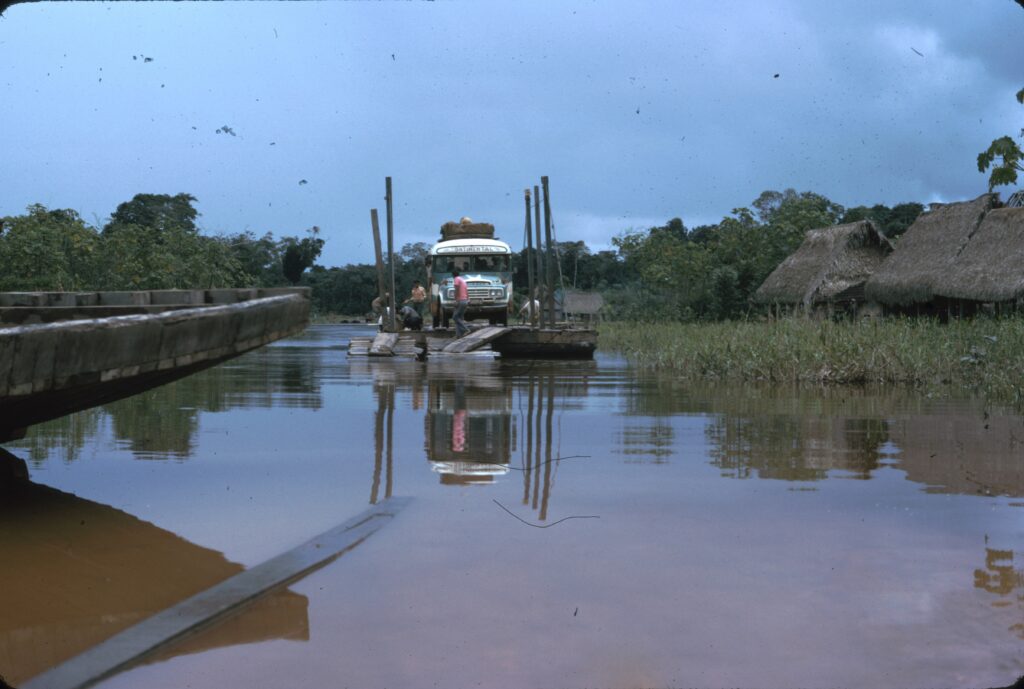
There were two drivers on the bus and no one was allowed to stand. You could hardly call it a "road" - it was a dirt track cut through the middle of the jungle. On the way, we kept seeing trucks and buses that had left the main lane and broken down. Several times all the passengers had to get out because the bus got stuck in deep ruts. There were 42 people on board.
At times the journey was quiet, then again a single shaking cup over longer distances. At least we were able to sit down.
Our bus gave up the ghost
We had been traveling for about ten hours when the bus suddenly gave up the ghost. The drivers kept trying to get it going, but the engine sounded strange. They pulled over. At the stop, there were two shacks made of planks with handmade benches. We were all able to go inside - thank goodness, because it started to rain again.
The drivers tried to fix something on the engine. After a while, they told us that we would have to wait (no cell phone) until the next bus, which left at 2 pm, would stop here and take us.
After a few hours of waiting, the bus arrived. The drivers of the broken bus had a big discussion with the new drivers. At first they didn't want to take us because no one was allowed to stand. After a long palaver, we were finally allowed to get on. The luggage was loaded onto the roof - the luggage hatches were already full. And off we went - standing for endless hours.
Including the incident, we were on the road for almost 40 hours. Rolf and I stood at the entrance to the bus. One of the drivers let us sit on the steps from time to time - it wasn't great, but it was better than just standing. The other driver dozed or slept and said nothing about our arrangement. However, when we changed drivers, the second driver wouldn't let us sit there for even a few minutes.
My legs were really sore. All of the 40-plus standing passengers massaged their legs in between. Whenever someone asked the drivers if there was still a long way to go, the answer was always the same: "We're almost there." And yet it went on for endless hours.
Suddenly, driving felt like riding on a cloud - the road was paved, a few kilometers before arriving in Cuiabá. What a relief: no more shaking, no more bouncing, no more holes.
On arrival at the bus station in Cuiabá, everyone on the bus was roaring and singing with joy, some of them clapping. The bus stopped and, despite all the inconvenience, we had arrived safely.
We got out of the car. Rolf and I looked at each other - we didn't need long sentences, we had the same thought: don't spend hours looking for a hotel. We went to the first hotel we came across at the bus station, looked at a room and the price - it was reasonable.
Once in the room, we dropped our rucksacks and went straight into the shower. When we looked at each other, our legs were swollen as if we were wearing astronaut suits. We immediately put our legs up - the pain slowly disappeared.
Discovery of a churrascaria
After a long rest and a bit of sleep, our stomachs started to rumble. We hadn't eaten a proper meal since La Paz. We all agreed that a nice piece of meat would do the trick. We got dressed and found exactly what we were looking for within a few minutes' walk - a churrascaria.
Pieces of chicken, pork, lamb and beef rotated on long skewers. As soon as you had eaten one piece, a waiter came with another. It was served with rice, potatoes, red beans, etc. You could eat as much as you wanted. We drank a chilled beer. Whether you ate a lot or a little - the price was the same.
How we would continue our journey had been on our minds for a few days. The plan was to stay in Brasília, the modern city in the middle of the jungle. We then wanted to travel to Rio de Janeiro with its many sights and wonderful beaches.

The plan was to travel to Europe via Africa
After our stay in Rio de Janeiro, we wanted to drive along the coast to Salvador da Bahia. There we wanted to see if we could find a boat or ferry to Senegal. If that didn't work out in Salvador, we would head further north to find a crossing to Senegal. At worst, we would opt for a flight to Dakar. From there via Mauritania, Morocco, Spain, France and back to Switzerland. That was the plan.
After a short break in Cuiabá, one morning we boarded the bus that took us to Brasília. The journey took several hours with short stops in between.
When we arrived in a suburb of Brasília, we quickly found a hotel. Rolf wasn't feeling well, vomited several times and was in a bad mood. We found a small snack bar nearby and went there for a small meal.
The next day, we set off on our own to visit this unique city. There were no guided city tours, just a small bus that took us from the suburbs into the city. We spent the whole day there marveling at how lavishly the land had been used: everything had been hewn out of the middle of the jungle, an artificial lake had been created and much more - including the underground church. (I enclose some pictures.)
On the way back to our hotel, we decided not to stay any longer but to continue on to Rio de Janeiro - also so that Rolf could see a doctor.

Brasilia to Rio de Janeiro and the hepatitis
We couldn't afford to fly, so we took the bus, which took about 18 hours from Brasília to Rio de Janeiro.
The bus station was next to the main train station. We booked the first hotel we could find and moved in. Rolf complained that he felt unwell and had no appetite.
I went to reception and asked for a phone book. The employee asked: "What's a phone book for?" At first I didn't understand the question, then he explained that the books were industry-specific. I asked for one with the name "Dottores". I don't remember how many entries it had. While looking through it, I suddenly came across a European-sounding name: Dr. Schaufelberger. I thought to myself that with a bit of luck we could communicate with this doctor.
Early the next day we went to reception and called this number. The lady answered in English. I explained that Rolf was feeling unwell. She told us we could come by immediately. The address was on Avenida Copacabana, in a better neighborhood.
We got into a cab and gave the driver the address. The doctor saw us straight away. He looked at Rolf and said without hesitation: "You have hepatitis." Rolf was already quite yellow.
The doctor, who spoke a little German, then said: "You now have two options:
They book a flight to Europe as quickly as possible and cure it there, or you stay here."


In between, he asked where we had got off. He made a head movement that said it all.
"The second option is to stay here in Rio, stay in a better hotel, eat healthily - lots of vegetables, fish, etc. - sleep a lot, no alcohol."
Rolf thanked us, paid the bill and we said goodbye. Back at our hotel near the station, we had a briefing. First we counted up the money - everyone's finances.
Rolf didn't feel like flying home sick. "Or if you'd rather fly home, I'll accompany you to the airport and stay here in Rio for a few more days."
So now we had to find the fare from Rio to Geneva. We called Swissair and received the information in French. We booked and bought the tickets for the return flight to Switzerland.
Our money was enough for four weeks of sightseeing and good food until our return.
We had a good time in Rio de Janeiro: good food - we had discovered the churrascaria. We also visited the Corcovado, Sugar Loaf Mountain and Cristo Redentor. We also took the special streetcar to Santa Teresa, which crossed a high bridge at the time. The beaches of Copacabana and Ipanema were among our visits, as were some good music clubs where Bossa Nova was played. We also attended a soccer match at the Maracanã stadium. It wasn't a special match, but there were still around 80,000 spectators. The military police were not to be trifled with - we saw a few operations, especially on the beach where there was zero tolerance.

Rolf and I thought we should dress up a bit for our arrival in Switzerland so that we didn't look like two dusty figures. So we went out and bought ourselves a new pair of trousers with a matching shirt.
Almost at the same time, we canceled our original plan to return home via Africa.
